.jpeg)
Macaroni Penguin
Scientific name: Eudyptes chrysolophus
Size: 5.2 kg (m), 5.3kg (f)
Nest type: in colonies in the open
Favourite food: krill
This is probably the most abundant of all penguins in terms of total numbers. Brood reduction is taken to an extreme by this species. The Royal Penguin (Eudyptes chrysolophus schlegeli), a white-faced variant, is treated as a subspecies of Macaroni Penguin here, but others accord the Royal penguin full species status.
 Identification:
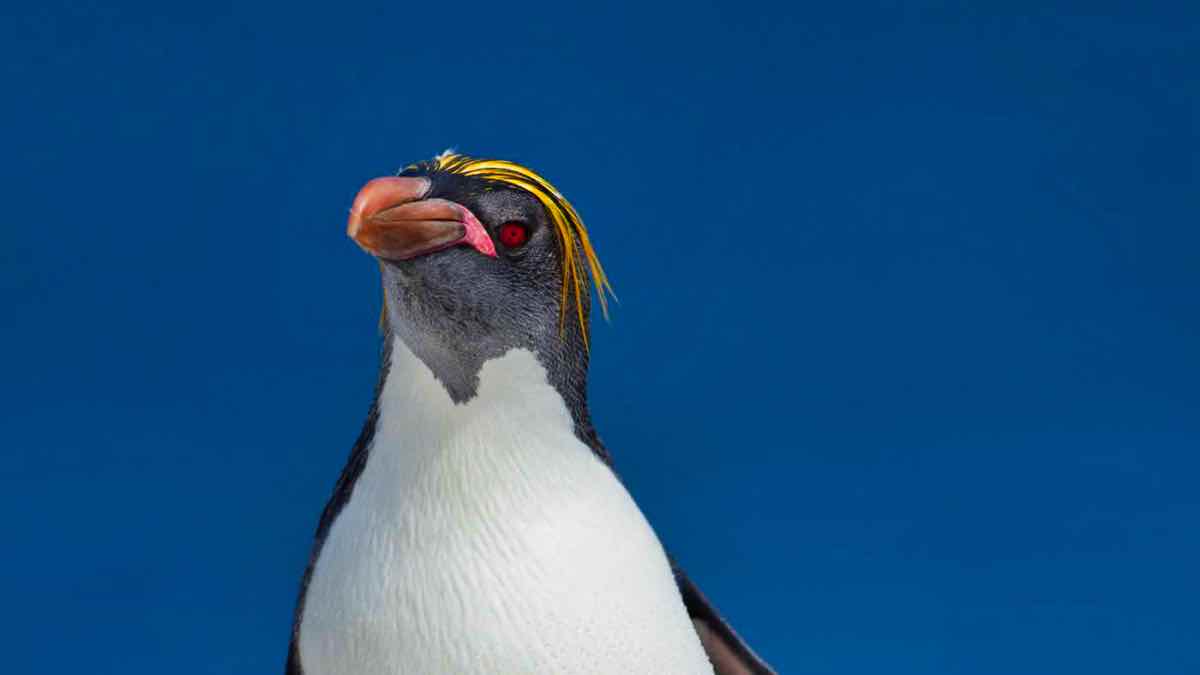
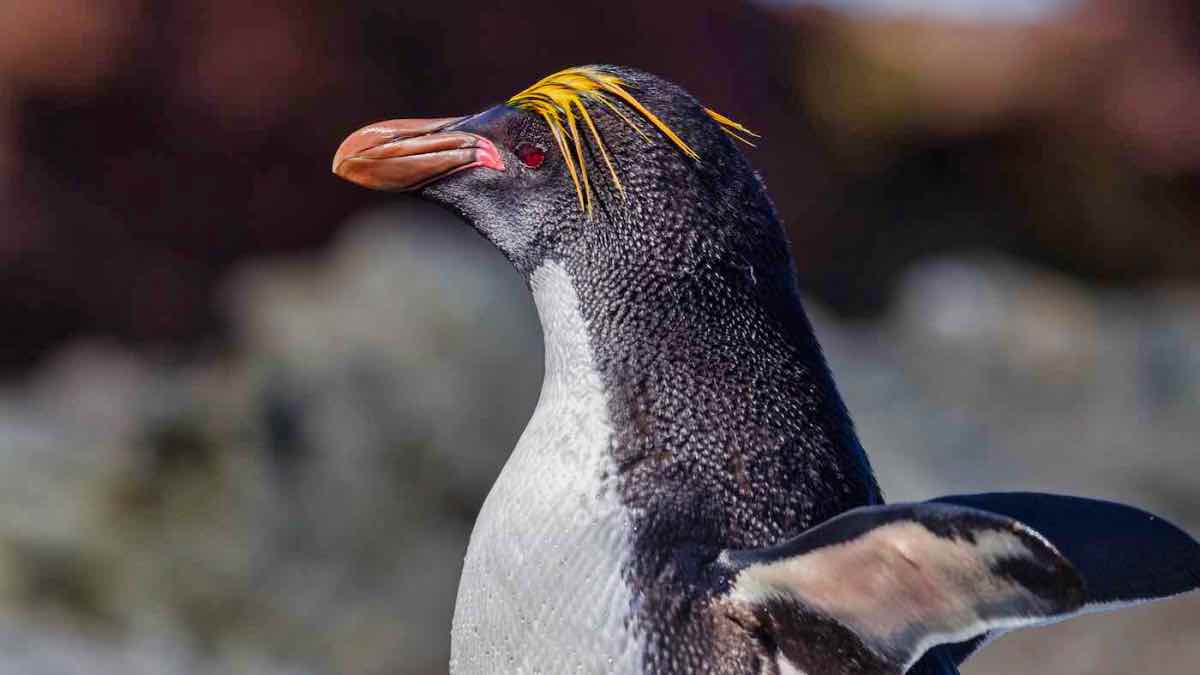
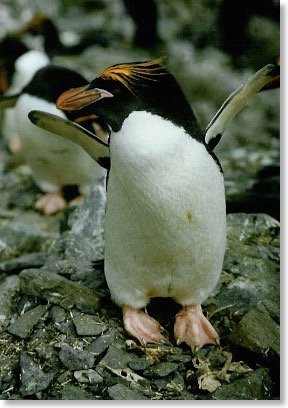
In contrast to the other crested Penguins, this species has orange, not yellow, feather plumes. They originate from a supercilium that meets at the front, i.e. higher up the head than in other species. Macaroni Penguins are also slightly larger than the other crested penguins. Most Macaroni Penguins breeding on Macquarie Island (south of Australia) have a white face and are referred to as Royal Penguins: they are sometimes given full species status (Eudyptes schlegeli), although the biological basis for doing so is very doubtful. Immatures are similar to adults but lack the long feather crest. Instead only a short orange-yellow supercilium is present.
Habits:
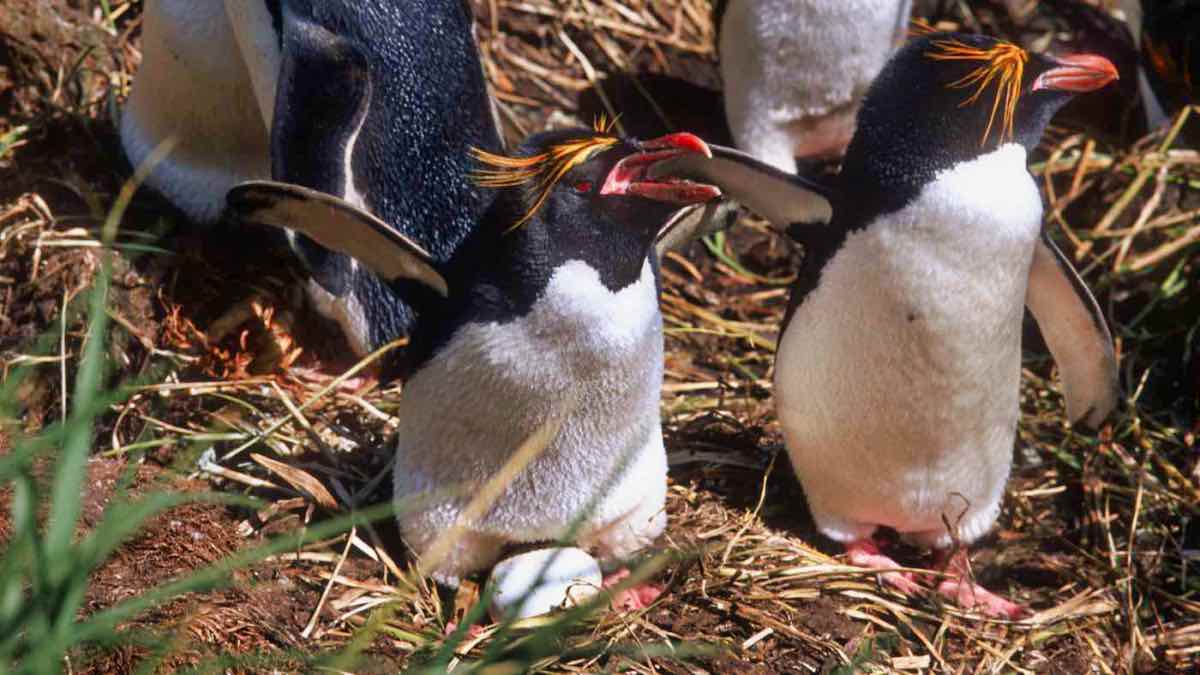
Breeds on rocky slopes, beaches and amongst tussocks. Most birds build a small nest from pebbles and by scraping out some mud or sand, but many pairs are content with laying their two eggs on bare rock. Egg-size dimorphism of Macaromi Penguins (and Erect-crested Penguins) is amongst the largest known for any bird. The first-laid A-egg is about 61-64% smaller than the B-egg. In most cases the A-egg is lost before or on the day the B-egg is laid, and it almost never survives to fledging even though the embryo is viable. Satellite telemetry studies indicate that Macaroni Penguins forage mainly along the polar front regularly travelling up to 400 km to reach a feeding site.
Distribution: map
The distribution of Macaroni Penguin extends from the sub-Antarctic to the Antarctic Peninsula, but overall they are found further south than the rest of the crested penguins. The range overlaps with that of the southern form of the Rockhopper Penguin. Breeding colonies are found on the Antarctic Peninsula, islands around Cape Horn, Falklands, South Georgia, South Sandwich, South Orkney, South Shetland, Bouvetøya, Prince Edward, Marion, Crozet, Kerguelen, Heard Island and Macquarie Island.
Migration and Vagrancy:
Macaroni Penguins are migratory and found only exceptionally near land during the non-breeding season. Vagrant dark-faced birds are known from South Africa, Antarctica, Campbell Island, and The Snares. Royal Penguins have been recorded, possibly breeding, on Heard, Kerguelen, Crozet Island, and Marion Island amongst dark-faced Macaroni Penguins and stragglers have been observed as far north as North Island, New Zealand.
Diet:
The diet is mainly composed of crustaceans. On Macquarie, euphausiids make up only half the diet by weight, with fish constituting the other half.
Size: 5.2 kg (m), 5.3kg (f)
Nest type: in colonies in the open
Favourite food: krill
This is probably the most abundant of all penguins in terms of total numbers. Brood reduction is taken to an extreme by this species. The Royal Penguin (Eudyptes chrysolophus schlegeli), a white-faced variant, is treated as a subspecies of Macaroni Penguin here, but others accord the Royal penguin full species status.
In contrast to the other crested Penguins, this species has orange, not yellow, feather plumes. They originate from a supercilium that meets at the front, i.e. higher up the head than in other species. Macaroni Penguins are also slightly larger than the other crested penguins. Most Macaroni Penguins breeding on Macquarie Island (south of Australia) have a white face and are referred to as Royal Penguins: they are sometimes given full species status (Eudyptes schlegeli), although the biological basis for doing so is very doubtful. Immatures are similar to adults but lack the long feather crest. Instead only a short orange-yellow supercilium is present.
Habits:
Breeds on rocky slopes, beaches and amongst tussocks. Most birds build a small nest from pebbles and by scraping out some mud or sand, but many pairs are content with laying their two eggs on bare rock. Egg-size dimorphism of Macaromi Penguins (and Erect-crested Penguins) is amongst the largest known for any bird. The first-laid A-egg is about 61-64% smaller than the B-egg. In most cases the A-egg is lost before or on the day the B-egg is laid, and it almost never survives to fledging even though the embryo is viable. Satellite telemetry studies indicate that Macaroni Penguins forage mainly along the polar front regularly travelling up to 400 km to reach a feeding site.
Distribution: map
The distribution of Macaroni Penguin extends from the sub-Antarctic to the Antarctic Peninsula, but overall they are found further south than the rest of the crested penguins. The range overlaps with that of the southern form of the Rockhopper Penguin. Breeding colonies are found on the Antarctic Peninsula, islands around Cape Horn, Falklands, South Georgia, South Sandwich, South Orkney, South Shetland, Bouvetøya, Prince Edward, Marion, Crozet, Kerguelen, Heard Island and Macquarie Island.
Migration and Vagrancy:
Macaroni Penguins are migratory and found only exceptionally near land during the non-breeding season. Vagrant dark-faced birds are known from South Africa, Antarctica, Campbell Island, and The Snares. Royal Penguins have been recorded, possibly breeding, on Heard, Kerguelen, Crozet Island, and Marion Island amongst dark-faced Macaroni Penguins and stragglers have been observed as far north as North Island, New Zealand.
Diet:
The diet is mainly composed of crustaceans. On Macquarie, euphausiids make up only half the diet by weight, with fish constituting the other half.