.jpeg)
Erect-crested Penguin
Scientific name: Eudyptes sclateri
Size: 5.2 kg (m), 5.1 kg (f)
Nest type: in colonies in the open; nest on rocks with little to no nesting material to line nests
Favourite food: krill and squid
A little-known rather bizarre bird with a limited breeding distribution in a very isolated part the world.
 Identification:
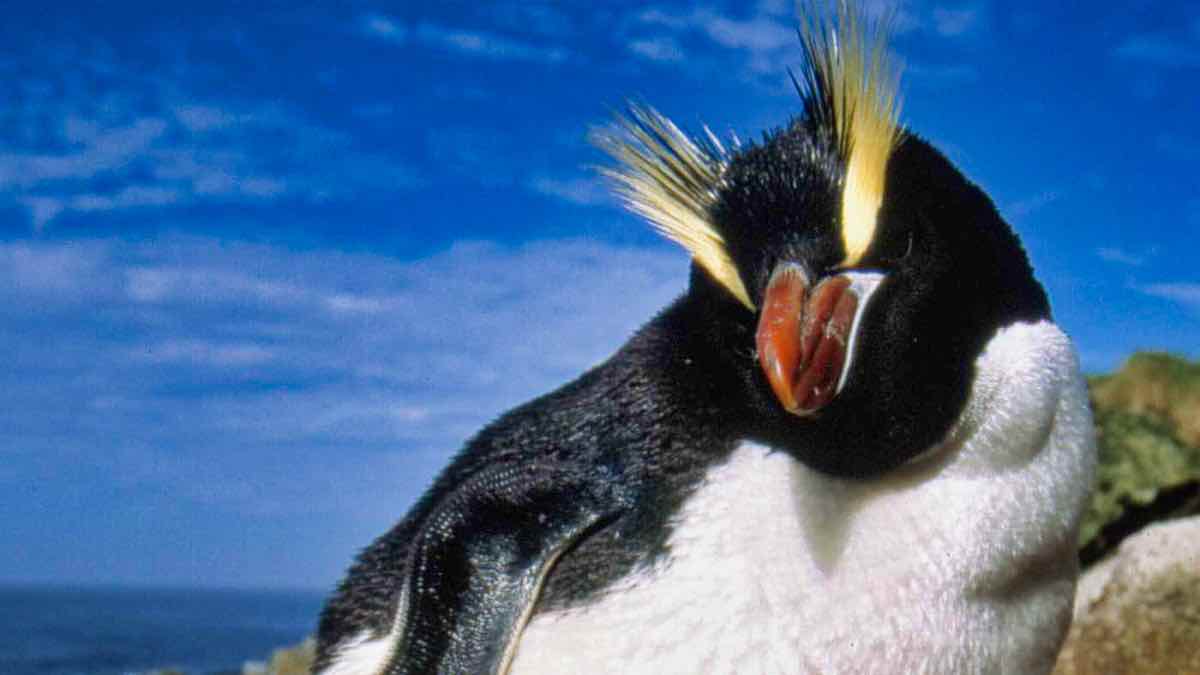
Similar to other crested penguins, in particular Snares and Fiordland Penguins. When dry on land Erect-crested Penguin can be identified by the upright yellow feather plumes of their crests. Erect-crested Penguins have a distinct gular pouch, a more parallel bill, and the yellow supercilium attaches higher on the bill than in Snares and Fiordland Penguins. Identification at sea is extremely difficult because feather plumes droop down when wet. Immatures have a pale yellow supercilium without the long plumes and a mottled grey throat. They can be distinguished from other crested penguins by the lower supercilium, size and gular pouch.
Habits:
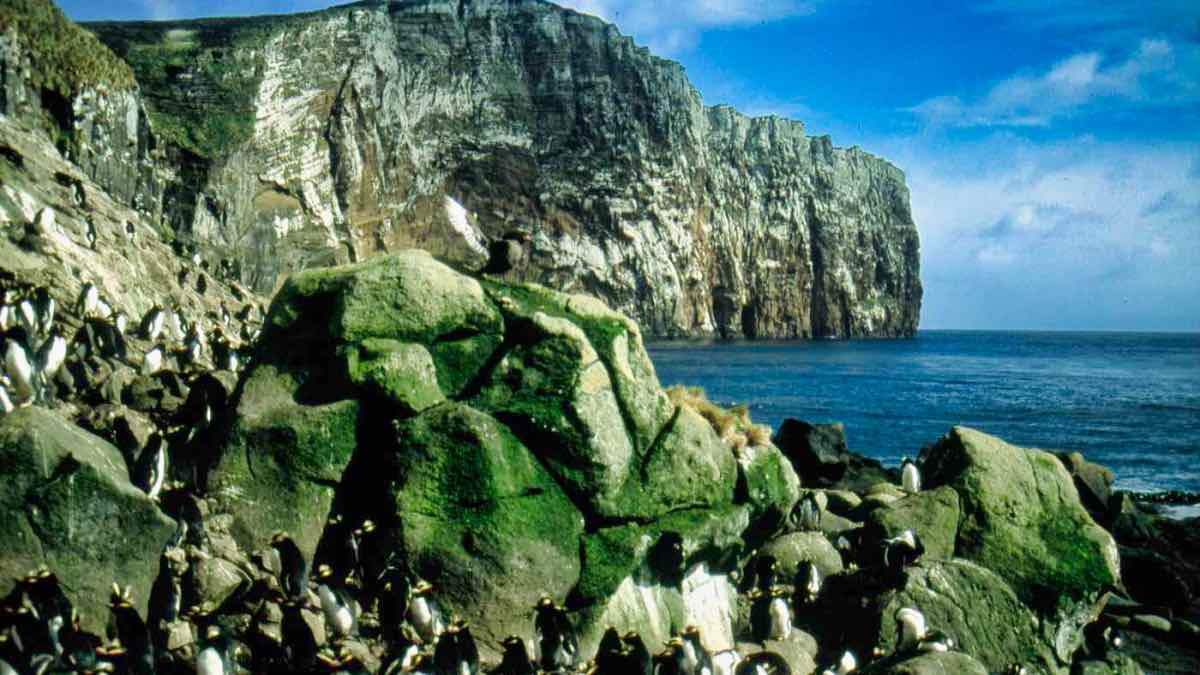
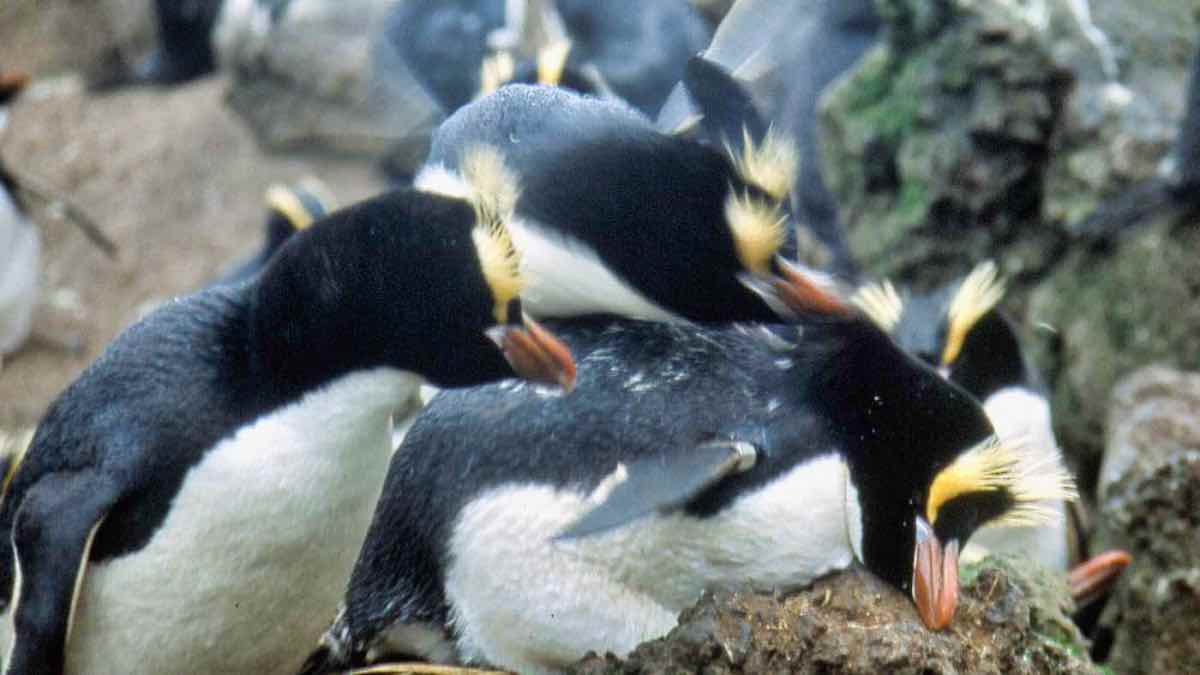
Erect-crested Penguins breed on rocky slopes bordering the shore. A few pairs build nests but most lay their eggs onto the bare rock. After a long courtship period two eggs are laid but the first, much smaller, A-egg is invariably lost, in most cases on the same day or before the B-egg has been laid.
Distribution: map
In an arc that characterizes the distribution of crested penguins, from the Antarctic Peninsula and South America through the sub-Antarctic islands in the Atlantic and Indian Oceans, Erect-crested Penguins form the terminal species in the east. They are now restricted to the Bounty and Antipodes Islands, with a few isolated pairs still breeding on the Auckland Islands. All these sites are south of the subtropical convergence but well north of the polar front. Until recently there were also some birds breeding on Campbell Island, but they seem to have disappeared from there now. Abundant sub-fossil material from the Chatham Islands has also been attributed to this species.
Migration and Vagrancy:
Erect-crested Penguins do not come to land after their post-breeding moult and their winter distribution at sea is unknown. Some birds moult regularly on other sub-Antarctic Islands south of New Zealand and, less commonly, on the South Island of New Zealand. Vagrants have been recorded from Northland (North Island of New Zealand), Tasmania, southern Australia, Heard Island and the Falkland Islands.
Diet:
Diet has never been studied in this species, but judging from its long foraging trips, like other crested penguins they probably live mainly on pelagic crustaceans and fish.
Size: 5.2 kg (m), 5.1 kg (f)
Nest type: in colonies in the open; nest on rocks with little to no nesting material to line nests
Favourite food: krill and squid
A little-known rather bizarre bird with a limited breeding distribution in a very isolated part the world.
Similar to other crested penguins, in particular Snares and Fiordland Penguins. When dry on land Erect-crested Penguin can be identified by the upright yellow feather plumes of their crests. Erect-crested Penguins have a distinct gular pouch, a more parallel bill, and the yellow supercilium attaches higher on the bill than in Snares and Fiordland Penguins. Identification at sea is extremely difficult because feather plumes droop down when wet. Immatures have a pale yellow supercilium without the long plumes and a mottled grey throat. They can be distinguished from other crested penguins by the lower supercilium, size and gular pouch.
Habits:
Erect-crested Penguins breed on rocky slopes bordering the shore. A few pairs build nests but most lay their eggs onto the bare rock. After a long courtship period two eggs are laid but the first, much smaller, A-egg is invariably lost, in most cases on the same day or before the B-egg has been laid.
Distribution: map
In an arc that characterizes the distribution of crested penguins, from the Antarctic Peninsula and South America through the sub-Antarctic islands in the Atlantic and Indian Oceans, Erect-crested Penguins form the terminal species in the east. They are now restricted to the Bounty and Antipodes Islands, with a few isolated pairs still breeding on the Auckland Islands. All these sites are south of the subtropical convergence but well north of the polar front. Until recently there were also some birds breeding on Campbell Island, but they seem to have disappeared from there now. Abundant sub-fossil material from the Chatham Islands has also been attributed to this species.
Migration and Vagrancy:
Erect-crested Penguins do not come to land after their post-breeding moult and their winter distribution at sea is unknown. Some birds moult regularly on other sub-Antarctic Islands south of New Zealand and, less commonly, on the South Island of New Zealand. Vagrants have been recorded from Northland (North Island of New Zealand), Tasmania, southern Australia, Heard Island and the Falkland Islands.
Diet:
Diet has never been studied in this species, but judging from its long foraging trips, like other crested penguins they probably live mainly on pelagic crustaceans and fish.