King Penguin
Scientific name: Aptenodytes patagonicus
Size: 16.0 kg (m), 14.3 kg (f)
Nest type: in colonies in the open, have territories but no nest
Favourite food: fish, some squid
No other bird has a longer breeding cycle than King Penguins. They take 14 to 16 months to fledge a single chick. During the winter, chicks may be left to fast for from one to five months (May to September/October). Adults can rear a maximum of only two chicks every three years.
 Identification:
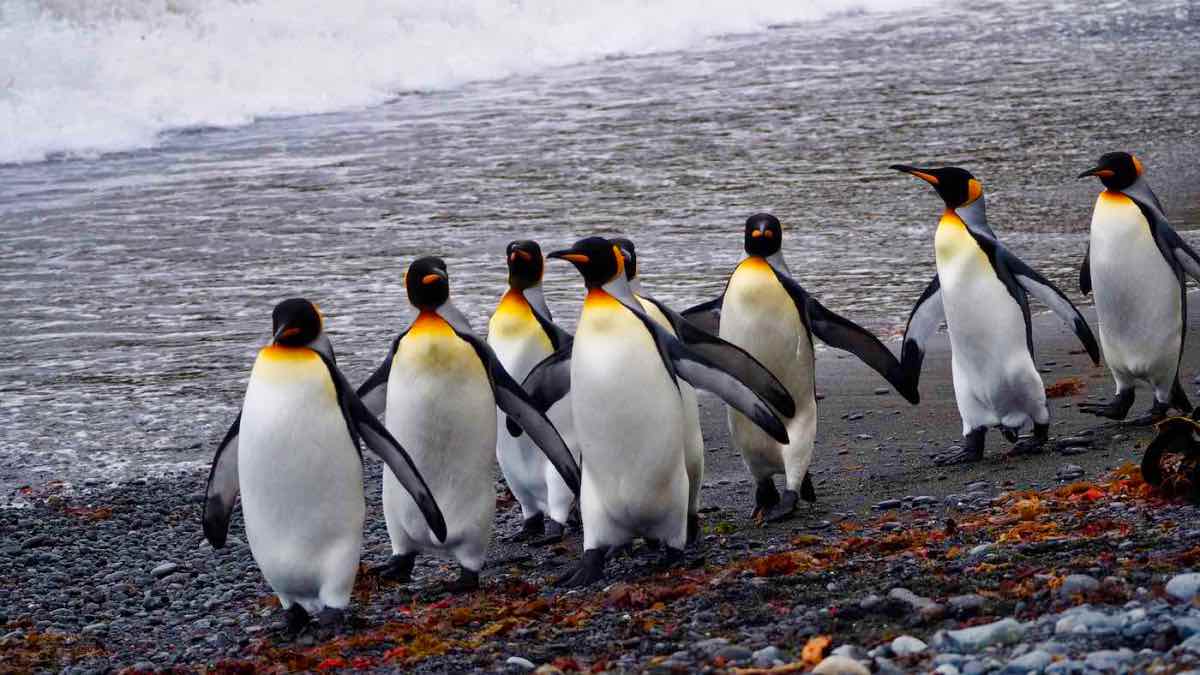
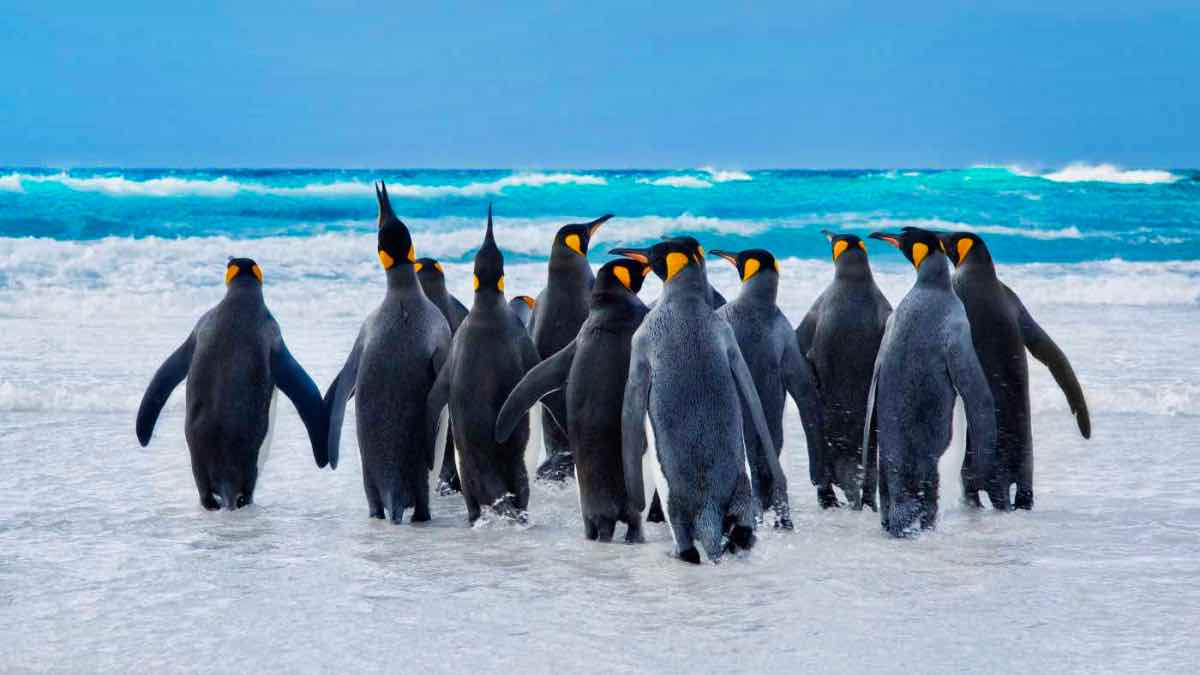
The second-largest penguin species, similar in appearance to Emperor Penguin, but their ranges do not usually overlap. Cheeks are dark orange. The belly is white but the back is paler than other penguins, more of a grey than black. Immatures are similar to adults, but with duller facial plumage. Ear patches are pale yellow rather than orange and the throat is grey-white. Reaches adult plumage after two years.
Habits:
Dense colonies, which can number several tens of thousand pairs, are located amongst tussocks, gently sloping beaches, and sometimes can be over a kilometre inland. No nest is built, but pairs still maintain territories within pecking distance of each other.
Distribution: map
Restricted to the sub-Antarctic belt, well north of Emperor Penguins. Breeding colonies are found on Falkland (re-colonised after extermination), South Georgia, Marion, Prince Edward, Crozet (over half of the world’s population), Kerguelen, Heard (re-colonised after extermination), and Macquarie Islands. At sea, King Penguins are usually found in ice-free waters. Telemetry studies have shown that they forage particularly along the polar front.
Migration and Vagrancy:
Due to the extended breeding cycle some birds can be found in the colony at any time of the year. During winter, adults leave their chicks unattended and may travel extensively before returning. Stragglers have reached the Antarctic Peninsula, Mawson, Gough Island, South Africa, southern Australia (including Tasmania), the North and South Islands of New Zealand, as well as New Zealand’s sub-Antarctic islands.
Diet:
King Penguins are specialised on pelagic fish, in particular laternfish of the species Electrona carlsbergi , Kreffichthys anderssoni and Protomyctophum tenisoni, which can make up over 99 % of the diet. Cephalopods play a minor role and, to an even lesser extent, so do crustaceans.
Size: 16.0 kg (m), 14.3 kg (f)
Nest type: in colonies in the open, have territories but no nest
Favourite food: fish, some squid
No other bird has a longer breeding cycle than King Penguins. They take 14 to 16 months to fledge a single chick. During the winter, chicks may be left to fast for from one to five months (May to September/October). Adults can rear a maximum of only two chicks every three years.
The second-largest penguin species, similar in appearance to Emperor Penguin, but their ranges do not usually overlap. Cheeks are dark orange. The belly is white but the back is paler than other penguins, more of a grey than black. Immatures are similar to adults, but with duller facial plumage. Ear patches are pale yellow rather than orange and the throat is grey-white. Reaches adult plumage after two years.
Habits:
Dense colonies, which can number several tens of thousand pairs, are located amongst tussocks, gently sloping beaches, and sometimes can be over a kilometre inland. No nest is built, but pairs still maintain territories within pecking distance of each other.
Distribution: map
Restricted to the sub-Antarctic belt, well north of Emperor Penguins. Breeding colonies are found on Falkland (re-colonised after extermination), South Georgia, Marion, Prince Edward, Crozet (over half of the world’s population), Kerguelen, Heard (re-colonised after extermination), and Macquarie Islands. At sea, King Penguins are usually found in ice-free waters. Telemetry studies have shown that they forage particularly along the polar front.
Migration and Vagrancy:
Due to the extended breeding cycle some birds can be found in the colony at any time of the year. During winter, adults leave their chicks unattended and may travel extensively before returning. Stragglers have reached the Antarctic Peninsula, Mawson, Gough Island, South Africa, southern Australia (including Tasmania), the North and South Islands of New Zealand, as well as New Zealand’s sub-Antarctic islands.
Diet:
King Penguins are specialised on pelagic fish, in particular laternfish of the species Electrona carlsbergi , Kreffichthys anderssoni and Protomyctophum tenisoni, which can make up over 99 % of the diet. Cephalopods play a minor role and, to an even lesser extent, so do crustaceans.